The batteries finally arrive
The Dyness batteries finally turn up two months after the panels, and a look at what the system did on its own before they arrived.
This picks up where the install post left off: panels on the roof, batteries on back-order.
The wait
The system ran panels-only for about two months. Whatever the roof generated went straight into the house. The evenings still ran on the grid.
There isn’t much to say about the wait itself. I didn’t chase anyone. Once the Dyness stock arrived, Solar Services Scotland got in touch and came back to fit them.
The kit
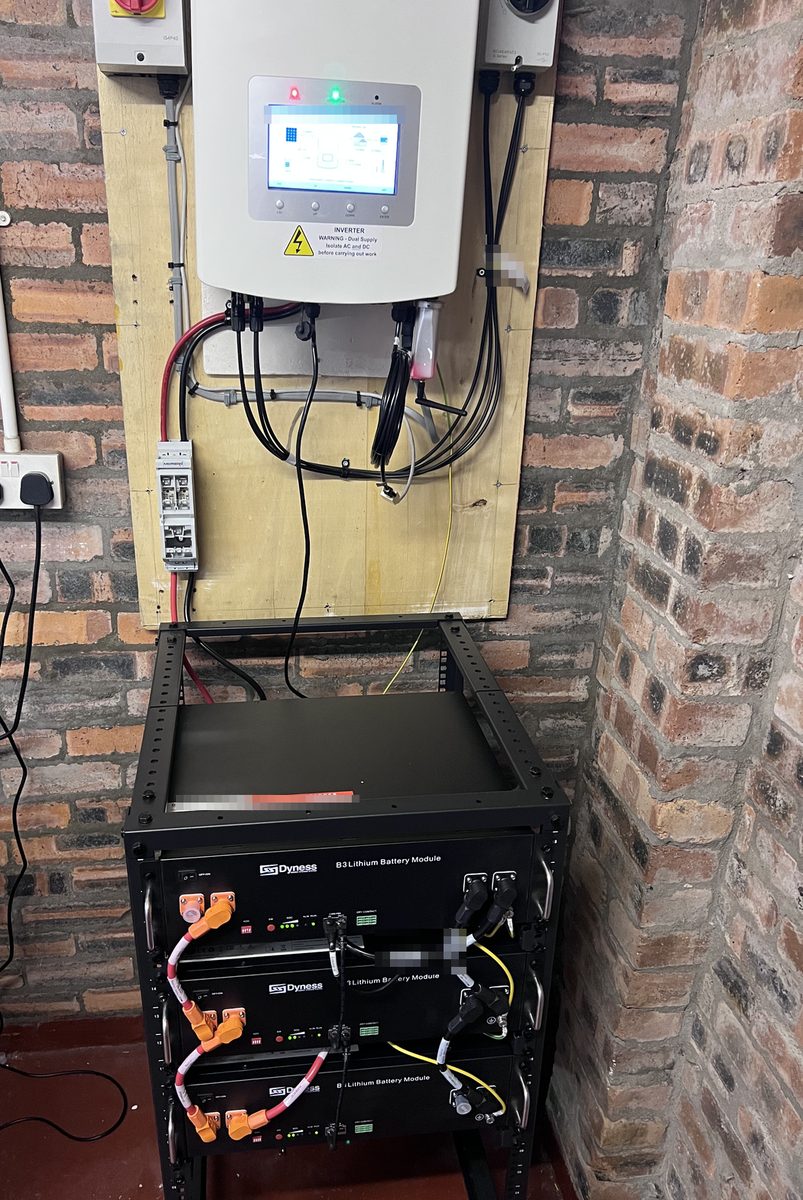
This is the swap from the 2 × Pylontech on the original quote:
- 3 × Dyness B3 modules
- 48 V / 75 Ah each, about 3.6 kWh per module
- 10.8 kWh in total
- Lithium iron phosphate (LFP) chemistry
- Stacked in the garage, next to the inverter
- Talks to the Solis inverter over CAN bus (a two-wire data link between the two)
Fitting day
The fitting took a morning. The three modules were stacked and wired in, the system was commissioned, and the installers were gone by lunch.
Two things I have learned since the panels went up. First, I wish I had asked for trunking up front. It is an easy thing to specify on the quote and a fiddlier job to add afterwards. Second, the tiles: where the roof hooks (the brackets that hold the mounting rails) pass between the tiles, the tiles should be notched to make room for them. I’m not sure whether that was done here. Two months on there’s no visible issue, so it’s on the list of things to keep an eye on rather than the list of things to worry about.
Two months of panels-only
Before the batteries, the Solarman app was already logging generation. The monthly figures to the end of June:
| Month | Generation | Note |
|---|---|---|
| April 2022 | 95 kWh | Part month, panels went up late April |
| May 2022 | 638 kWh | First full month |
| June 2022 | 704 kWh | Best month yet |
Grid import has been tiny on sunny days, even without storage. It has stayed at no more than a few tens of kWh a month.
First impressions with storage
The difference is in the evenings. The battery soaks up the daytime surplus and the house runs off it after the sun goes down. On a sunny day, grid import now drops to almost nothing.
I have also started checking the Solarman app far more often than is healthy. Watching the battery percentage climb through the afternoon is surprisingly absorbing.
The obvious next thought is winter. The panels will produce far less, and the battery will have little surplus to store. But if the battery can be charged from the grid overnight, a cheaper night-rate tariff might make the maths work in winter too. That is an idea to look into, not a decision.
What’s next
- See how autumn goes as generation drops off
- Look into night-rate tariffs and whether grid charging the battery stacks up
- See whether the Solarman app is enough, or whether I want something more detailed
I wrote this post with help from AI tools (Claude, Codex). I review, edit and check everything before publishing. How I use AI